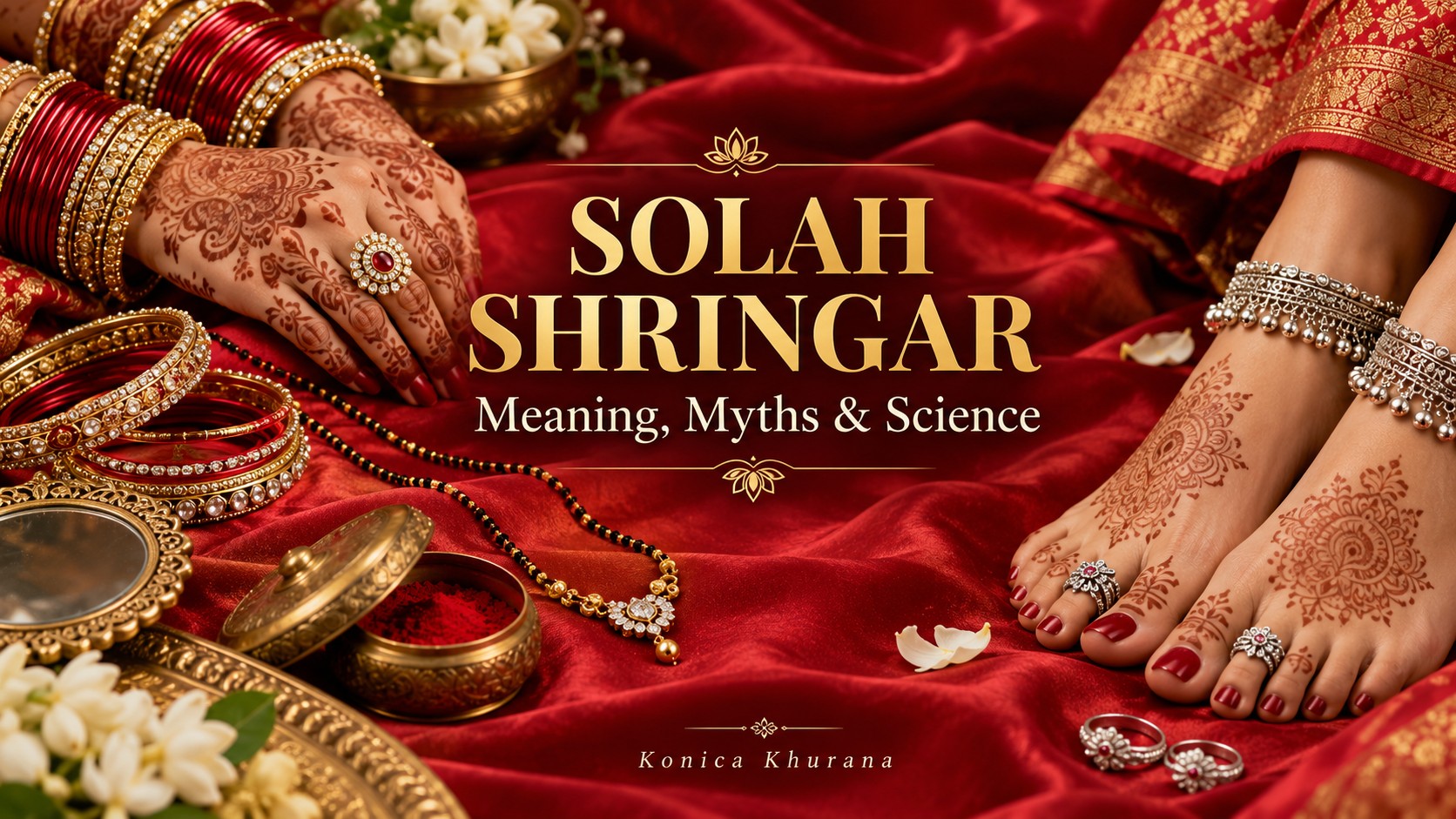
A bindi, a pair of bangles, mehndi-covered hands—what do these beautiful traditions really mean? Discover the cultural significance of Karva Chauth shringar and understand the difference between traditional beliefs and scientific evidence.
By Konica Khurana
Karva Chauth is often remembered for its decorated puja thali, moon-viewing ritual and beautiful festive outfits. For many women, getting ready is also an emotional experience: wearing wedding bangles again, choosing a favourite sari or applying mehndi with family members.
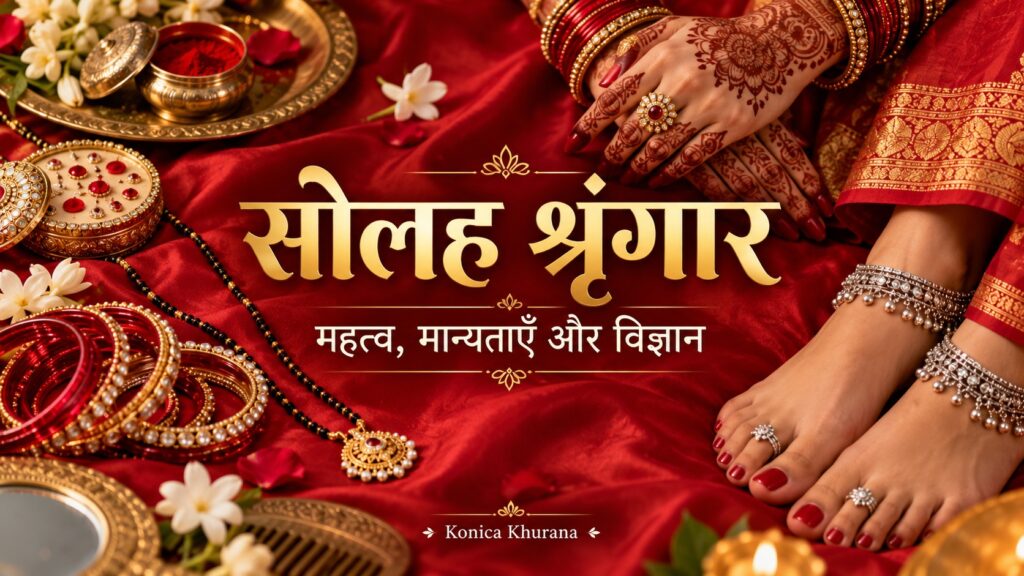
These details are often connected with solah shringar, the traditional concept of sixteen adornments.
But what does each item represent? Is wearing all sixteen compulsory? Do toe rings really improve fertility, and does darker mehndi mean your husband loves you more?
Let us explore these traditions with respect for Indian culture while keeping scientific claims separate from symbolism.
What Is Solah Shringar?
Solah shringar means sixteen adornments traditionally associated with beauty, celebration and bridal dressing. On Karva Chauth, many married women include these adornments as an expression of festivity and their connection with marriage traditions.
The exact list varies across regions and communities. Some lists include bathing, clothing or fragrance, while others count particular jewellery items separately. There is no single styling checklist followed identically in every Indian home.
What Are the Sixteen Shringar Items?
One commonly encountered version includes:
| No. | Shringar item | What it is |
|---|---|---|
| 1 | Bindi | Decorative mark worn on the forehead |
| 2 | Sindoor | Vermilion traditionally applied in the hair parting |
| 3 | Maang tikka | Jewellery resting along the hair parting and forehead |
| 4 | Kajal | Eye cosmetic used in traditional dressing |
| 5 | Earrings | Jhumkas, kundal or other ear ornaments |
| 6 | Nath | Nose ring or nose ornament |
| 7 | Necklace or mangalsutra | Neck ornament, with marital significance in communities using a mangalsutra |
| 8 | Bangles | Choodiyan or other wrist ornaments |
| 9 | Mehndi | Henna designs applied to the hands or feet |
| 10 | Finger rings | Rings worn as part of festive jewellery |
| 11 | Bajuband | Ornament worn on the upper arm |
| 12 | Kamarband | Decorative waist ornament |
| 13 | Payal | Anklets |
| 14 | Bichiya | Toe rings |
| 15 | Fragrance | Perfume or traditional ittar |
| 16 | Gajra | Flowers worn in the hair |
Treat this as a reference for understanding the tradition, rather than a compulsory shopping list.
1. Bindi: Auspiciousness, Beauty and Focus
A bindi is one of the most recognisable elements of Indian adornment. It can complete a festive look with something as simple as a small red dot.
In many traditions, it represents auspiciousness. Some spiritual interpretations connect its forehead position with the ajna point, associated with awareness and focus.
On Karva Chauth, a woman may choose a bindi that complements her sari, jewellery or bridal style. Its meaning can also be personal—a familiar detail remembered from her mother or grandmother.
What does science say?
A cosmetic bindi has not been established as a way to activate the brain, balance hormones or treat a health condition. Its spiritual interpretation should not be presented as a proven medical effect.
You can appreciate its beauty and symbolism without needing a medical explanation.
2. Bangles: Celebration and Married-Life Traditions
The sound of choodiyan is closely associated with festive dressing in many Indian households. Bangles may represent celebration and, in some communities, married status.
On Karva Chauth, wearing wedding bangles again can bring back memories of the wedding day. Other women prefer a comfortable new set that matches their outfit.
Colours and materials differ between families. Glass bangles, metal bangles, bridal chooda and other styles belong to different traditions; they should not all be treated as interchangeable religious requirements.
What does science say?
Claims that bangles improve fertility or that their movement provides a clinically meaningful circulation benefit are not established medical facts.
Choose bangles that fit comfortably. Their cultural value does not depend on a health claim.
3. Bichiya: The Cultural Meaning of Toe Rings
Bichiya, or toe rings, are a recognised symbol of marriage in many Indian communities. They are often made of silver and commonly worn on the second toes, although practices vary.
For women whose families follow this tradition, bichiya may be part of everyday married-life dressing as well as Karva Chauth shringar.
What does science say?
A popular explanation claims that toe rings press a nerve connected with the uterus and therefore regulate periods or improve fertility. This should not be presented as an established scientific benefit.
Toe rings are jewellery, not a treatment for menstrual or fertility concerns. Persistent symptoms deserve appropriate medical advice.
Their cultural meaning remains valuable without attaching an unproven treatment claim.
4. Payal: Beauty, Movement and Family Memories
Payal, or anklets, add a familiar sound and decorative detail to traditional dressing. In many families, a pair of anklets may also be a meaningful wedding gift or an inherited piece.
Unlike some marital symbols, anklets are also worn by unmarried women and girls. Their meaning depends on the community and occasion.
On Karva Chauth, payal can complete a festive outfit, but wearing them is a matter of custom and comfort.
What does science say?
Silver anklets are not an established way to remove toxins, balance the body’s energy or treat illness. A material having particular properties does not automatically mean that wearing jewellery made from it produces a health benefit.
5. Mangalsutra: A Marriage Symbol, with Regional Differences
A mangalsutra represents marriage in communities that use it. Its design, beads, pendant and wedding significance can differ considerably.
For some women, wearing it on Karva Chauth feels like reconnecting with their wedding promises. For others, different ornaments hold that place in their family tradition.
Not every Indian community uses a mangalsutra. Its absence should not be treated as evidence of a weaker marriage or incomplete devotion.
What does science say?
Claims that mangalsutra beads protect the heart, regulate blood pressure or extend a husband’s life are not established medical benefits.
Its strongest meaning is cultural and personal: what the relationship and its commitments represent to the wearer.
Want to reflect on the emotional connection in your relationship? Get Your Love Reading. Bring your questions about your own feelings, expectations and choices. A reading cannot prove another person’s private thoughts.
6. Mehndi: Festive Joy and the Myth of the Dark Stain
Mehndi is often one of the most enjoyable preparations for Karva Chauth. Choosing a design, sitting with friends and waiting for the colour to develop can become part of the celebration itself.
It represents festive beauty and shared preparation. For a newlywed woman, it may also bring back memories of her wedding mehndi.
Then comes the familiar saying: “The darker your mehndi, the more your husband loves you.”
This is a playful folk belief, not a relationship test. A henna stain cannot measure love, loyalty or compatibility. Do not compare your colour with someone else’s or feel disappointed if yours develops differently.
What should you know about product safety?
“Black henna” may contain added ingredients such as PPD, which can cause serious skin reactions. Even products marketed as henna can contain other additives. The FDA’s henna and temporary tattoo guidance discusses these risks.
If a product causes irritation, stop using it and seek medical advice where needed.
7. Sindoor: A Symbol of Marriage in Many Traditions
Sindoor is traditionally associated with marriage in many Hindu communities. On Karva Chauth, women who follow this custom may include it as part of their festive dressing.
Its emotional meaning may come from the wedding ceremony, family tradition or the wearer’s personal connection with marriage.
However, not every community follows an identical practice.
What does science say?
Sindoor should not be described as a treatment for stress, hormonal problems or other medical conditions. Applying it does not scientifically guarantee marital well-being.
The meaning lies in the tradition and the person’s relationship with it.
Why Are So Many “Scientific Reasons” Shared Online?
You may have read statements such as:
- “Toe rings activate nerves connected to fertility.”
- “Bangles improve blood circulation.”
- “Silver anklets remove toxins.”
- “A bindi activates the brain.”
- “Mangalsutra beads protect the heart.”
These explanations can sound convincing because they mention nerves, metals, pressure points or energy.
But a plausible-sounding explanation is not the same as reliable evidence.
To establish a health benefit, evidence must examine the actual practice and the claimed outcome. Research about silver, for example, does not automatically prove that wearing silver anklets improves health.
It is more accurate to describe spiritual explanations as beliefs unless relevant scientific evidence supports them. Indian traditions can be appreciated for their beauty, history and emotional meaning without presenting every custom as a medical discovery.
Must You Wear All Sixteen Items on Karva Chauth?
Your celebration does not need to become an expensive shopping exercise.
Choose adornments that:
- Feel comfortable.
- Suit your family’s customs.
- Fit your budget.
- Carry personal meaning.
- Help you enjoy the occasion.
A familiar pair of bangles or an inherited necklace can feel more special than a completely new jewellery set.
You should not feel pressured to wear something painful, irritating or financially uncomfortable. Nor should women be compared according to how closely they resemble a bridal photograph.
A Simple Karva Chauth Remedy: Connect Shringar with a Kind Intention
You can turn getting ready into a quiet moment of prayer and reflection.
Choose one adornment as a personal reminder:
- Bindi: Pause before reacting.
- Bangles: Speak with kindness.
- Mehndi: Make time for your relationship.
- A meaningful necklace: Remember a promise you want to honour.
Then say:
“May my words and actions bring respect, patience and care into our relationship.”
Complete the intention with one practical action that evening. Listen without interrupting, express appreciation or make a small plan to spend time together.
This is a suggested symbolic practice, not a compulsory traditional ritual or a guarantee of relationship harmony. The ornament serves as a reminder; the meaningful part is how you act.
When the Celebration Looks Beautiful but the Relationship Feels Difficult
Sometimes the clothes, jewellery and photographs look perfect while a couple feels disconnected.
You may be celebrating together but struggling with repeated misunderstandings, unmet expectations or a lack of meaningful conversation.
A beautiful ritual can create an opportunity to reconnect, but it cannot replace an honest discussion.
Try beginning with something specific:
“I would like us to spend a little time together without phones. There is something I want to share calmly.”
If you want space to reflect on your concerns, Get Your Relationship Reading. Use it to explore your own questions and possible next steps. It cannot guarantee reconciliation, establish whether someone is faithful or replace professional counselling.
Frequently Asked Questions
What is the main significance of solah shringar on Karva Chauth?
It is a traditional form of festive and bridal adornment associated with beauty, celebration and marriage symbolism in many communities. The exact items and meanings vary.
Is wearing a mangalsutra compulsory for everyone?
No. Marriage symbols differ across India. Follow your own tradition rather than assuming one community’s practice applies to everyone.
Do toe rings regulate periods or improve fertility?
These benefits have not been established as medical effects of wearing toe rings. They should not be used as a treatment.
Does darker mehndi mean greater love?
No. The colour of a stain does not measure love or relationship quality.
Can unmarried women wear bangles, a bindi, mehndi or anklets?
Many of these adornments are also worn by unmarried women. Specific marital symbols should be understood in the context of the relevant family or community.
What if I prefer simple shringar?
A simple look can still be meaningful and festive. Comfort, personal preference and family tradition matter more than buying every item.
For questions about your emotional connection, Get Your Love Reading. For ongoing relationship concerns, Get Your Relationship Reading.