Basic Tarot for Beginners
Have you ever looked at a tarot deck and wondered how someone can interpret its colourful pictures? Do the cards have fixed meanings? And do you need a special gift to understand them?
Learning tarot begins with getting familiar with the cards, observing their imagery, and exploring how their traditional meanings relate to a question.
This beginner’s guide will help you take that first step.
How Many Cards Are in a Tarot Deck?
A traditional tarot deck contains 78 cards, divided into two groups: the Major Arcana and the Minor Arcana.
| Group | Number of Cards | Common Themes |
|---|---|---|
| Major Arcana | 22 | Significant experiences, life lessons, and major changes |
| Minor Arcana | 56 | Everyday situations, emotions, thoughts, actions, and responsibilities |
An easy way to remember the difference is:
Major Arcana represents the bigger chapters of a story. Minor Arcana explores the everyday events within those chapters.
Interpretations can vary between tarot traditions and decks.
What Are the Four Tarot Suits?
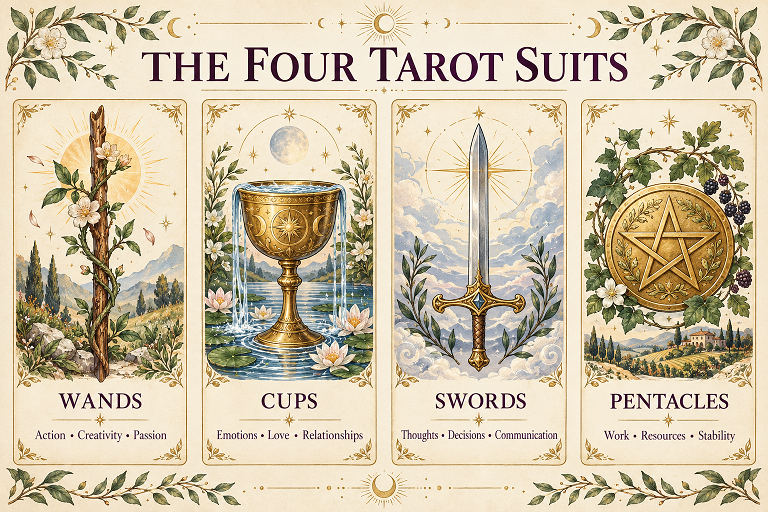
The Minor Arcana contains four suits, each with 14 cards: Ace through Ten, followed by Page, Knight, Queen, and King.
Their common associations are:
| Suit | Common Associations | A Question to Explore |
|---|---|---|
| Wands | Motivation, creativity, initiative, and action | What am I ready to begin? |
| Cups | Feelings, relationships, and emotional experiences | How do I feel about this situation? |
| Swords | Thoughts, communication, decisions, and conflict | What needs clearer thinking? |
| Pentacles | Work, resources, practical needs, and stability | What can I build or organise? |
These associations are starting points. A card’s meaning also depends on the question and its position in a reading.
What Happens During a Tarot Reading?
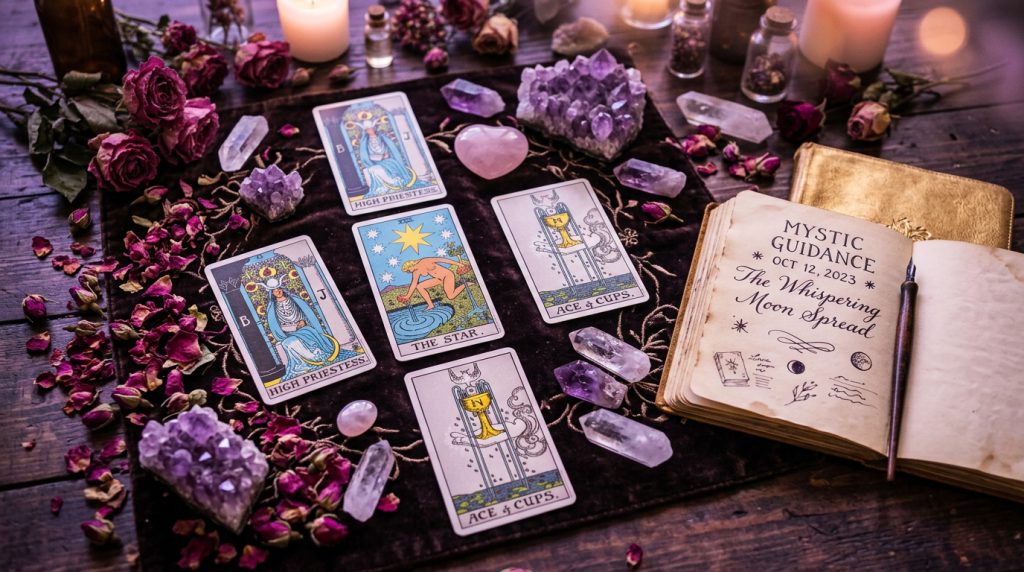
A reader begins with a question and draws one or more cards. They consider the cards’ imagery, traditional meanings, and positions in a layout, known as a spread.
The interpretation offers a way to reflect on the situation.
For example, a question about starting a project might lead you to consider your preparation, available resources, or hesitation about taking the first step.
Many people approach tarot as a spiritual practice. Others use it as a prompt for journaling and personal reflection. A reading should not be treated as proof of future events or another person’s private thoughts.
Learn how to use a simple three-card tarot spread.
A Simple Example for Beginners
Imagine you are preparing to launch an online course. You ask:
“What should I consider before taking my next step?”
As you look at the card, write down:
- What catches my attention first?
- What is happening in the picture?
- How might the traditional meaning relate to my question?
- What practical action could I consider?
Perhaps the image makes you think about preparation. You might decide to organise your lesson outline or record a short practice video.
That action comes from reflecting on the card alongside your real circumstances. The card does not guarantee that your course will succeed.
Do You Need a Special Gift to Learn Tarot?
You can begin by studying the cards and practising observation. You do not need to prove that you have a special ability before opening a deck.
Intuition can be part of your interpretation, but it helps to balance personal impressions with the deck’s guidebook and the facts of the situation.
There is also no need to memorise every possible meaning at once. Start small and allow your understanding to develop through practice.
Your First Tarot Practice
Choose one card and spend a few minutes looking at it before checking the guidebook.
In a notebook, make three short entries:
What I noticed → What the guidebook says → How I understand the connection
You might notice a person’s expression, an object they are holding, or the landscape behind them. Record what you actually see before deciding what it means.
After reading the guidebook, note where your observation matches the traditional interpretation and where it differs. Uncertainty is a useful part of learning.
Common Questions About Tarot
Can I read tarot for myself?
Yes. Keep your question focused and write down your interpretation. Remember that your hopes or worries can influence how you understand a card.
Does every card have one fixed meaning?
Cards have established associations, but their interpretation depends on context. Avoid treating a single keyword as the answer to every question.
Does an uncomfortable-looking card mean something bad will happen?
No. A difficult image is not evidence that a harmful event will occur. Read it in context and avoid jumping to frightening conclusions.
Begin with Curiosity
Your first goal is to become familiar with the cards. Observe, study, ask questions, and keep a record of what you learn.
Use tarot to explore your perspective while keeping practical decisions grounded in reliable information and your own judgment.
Explore more beginner-friendly tarot articles at konicakhurana.com.
By Konica Khurana — Jyotish Acharya, Tarot Reader & Healer