
By Konica Khurana
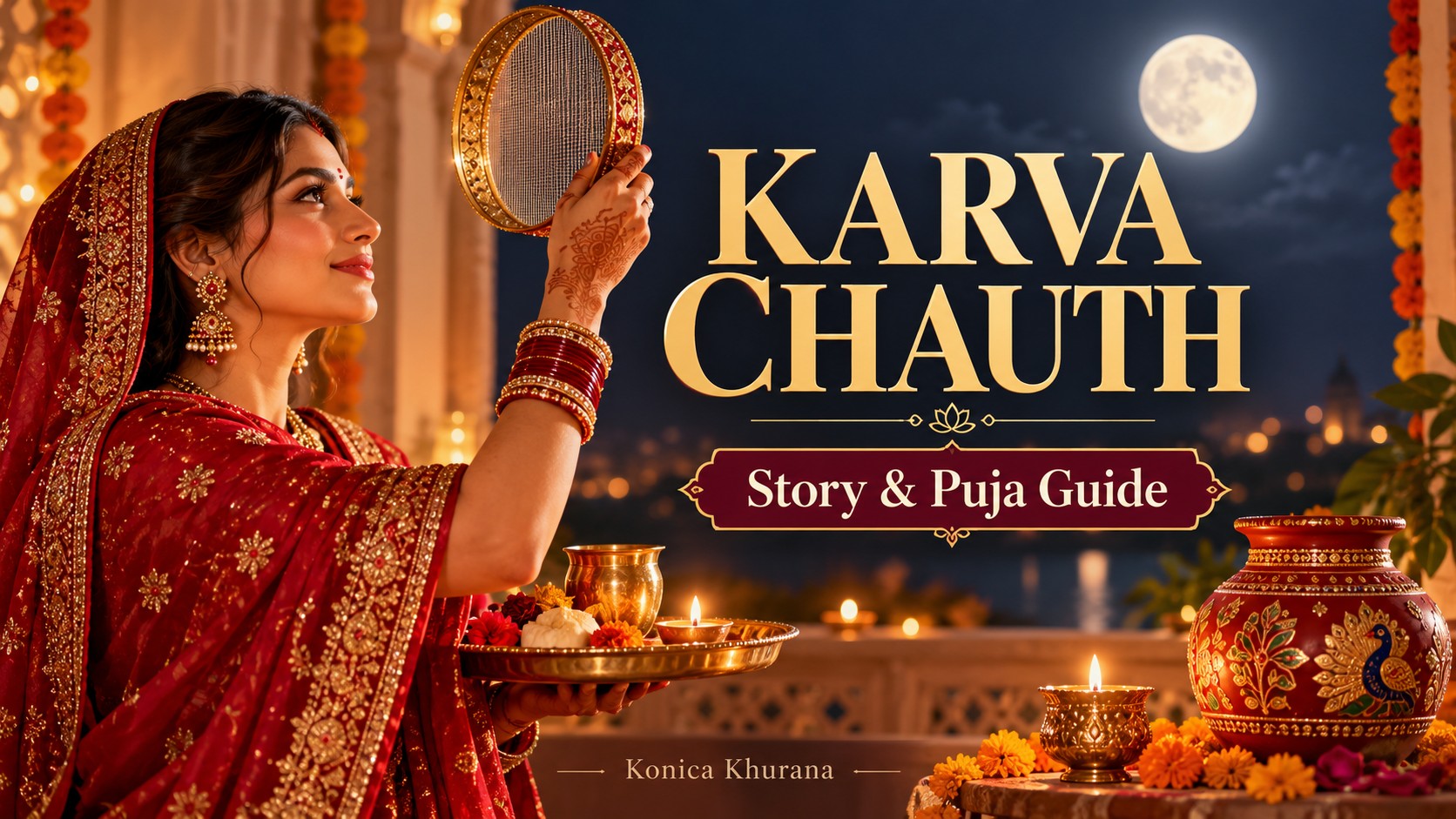
Karva Chauth often brings a familiar picture to mind: a decorated thali, mehndi-covered hands and a family waiting for the moon. But if you have never observed it, the questions usually begin much earlier. What does the festival mean? Which story is read? And does every household follow the same rules?
Karva Chauth is a Hindu observance associated with prayers for a husband’s well-being and married life. It is especially familiar in many North Indian communities. A traditional fast ends after the evening observance and moon sighting. Families differ in their exact practices; this guide is an introduction, not a replacement for your household’s tradition. [1]
What does the name mean?
A karva is a small pot used in the ritual, while chauth refers to the fourth lunar day. In the North Indian Purnimanta calendar, the festival falls on Kartik Krishna Chaturthi. Other calendar conventions may give a different month name for the same observance.
Check a location-specific panchang for the relevant year rather than reusing last year’s date or another city’s moonrise time. Keep your puja arrangements ready before the evening so that the celebration does not become a last-minute rush.
The Veeravati story in brief
In one popular telling, Veeravati’s brothers cannot bear to see their fasting sister distressed. They create the appearance of moonrise, and she breaks her fast too soon. A tragedy involving her husband follows. Through renewed devotion and observance, she eventually regains him. Versions differ in the details and sequence of events. This is a religious legend, not a factual prediction about what happens if someone cannot fast. [3]
A gentle way to share the story with children is to discuss honesty, care and patience. There is no need to frighten a new bride with the suggestion that a mistake will cause her husband harm.
A simple puja preparation guide
Prepare a clean place and ask the person leading your household puja for its samagri list. Common arrangements include a karva, water, a thali, a lamp, flowers, roli, rice and an offering. Images or representations of the deities, the katha, and the order of worship follow family practice. In the evening, families perform puja, hear the story and later offer water to the moon before ending the fast. [4]
Use this practical sequence for planning:
- The previous day, confirm the puja location, katha leader and items needed.
- Set aside your clothes and comfortable jewellery.
- Plan the pre-dawn meal if your family observes sargi.
- Arrange the evening meal in advance and share the cooking work.
- Keep the balcony or terrace accessible for moon sighting.
- Follow your agreed family practice for the closing ritual.
The sieve scene seen in films is familiar, but a cinematic sequence should not be treated as the rule for every community.
Wondering how to bring more understanding into your relationship? Get Your Love Reading. Use a reading as a reflective conversation about your questions and choices, rather than proof of another person’s private feelings.
One Karva Chauth remedy: a gratitude sankalp
After your prayers, sit quietly and say: “May our home have patience, respect and kindness. May we both act with care.” Think of one quality you appreciate in your partner and tell them that evening.
Then choose one action you can repeat: listening without checking your phone, sharing a task or speaking more calmly during disagreements. This is a suggested devotional practice, not a prescribed scriptural remedy or a promise of a particular result.
Frequently asked questions
Is Karva Chauth celebrated the same way across India?
No. It is not universal among Indian families. Community, region and household tradition all shape the celebration.
Does a difficult fast prove greater love?
No. Love is shown through everyday care. Discuss any health-related fasting decisions with a qualified clinician and your family rather than treating endurance as a competition.
What if the couple is living apart?
Plan a phone or video conversation, share your wishes and clarify your family’s closing ritual beforehand. Physical distance does not prevent gratitude or supportive communication.
If misunderstandings keep returning, Get Your Relationship Reading to explore your own concerns and next steps. A reading cannot guarantee reconciliation or replace counselling where it is needed.
Read next: First Karva Chauth: Sargi, Bayna and Gifts.
Sources: [1] https://www.incredibleindia.gov.in/en/festivals-and-events/karva-chauth • [2] https://en.wikipedia.org/wiki/Karva_Chauth • [3] https://www.drikpanchang.com/festivals/karwa-chauth/legends/karwa-chauth-legends.html • [4] https://www.drikpanchang.com/festivals/karwa-chauth/info/karwa-chauth-puja-vidhi.html
First Karva Chauth? Sargi, Bayna and Gifts Explained
By Konica Khurana
SEO publishing fields
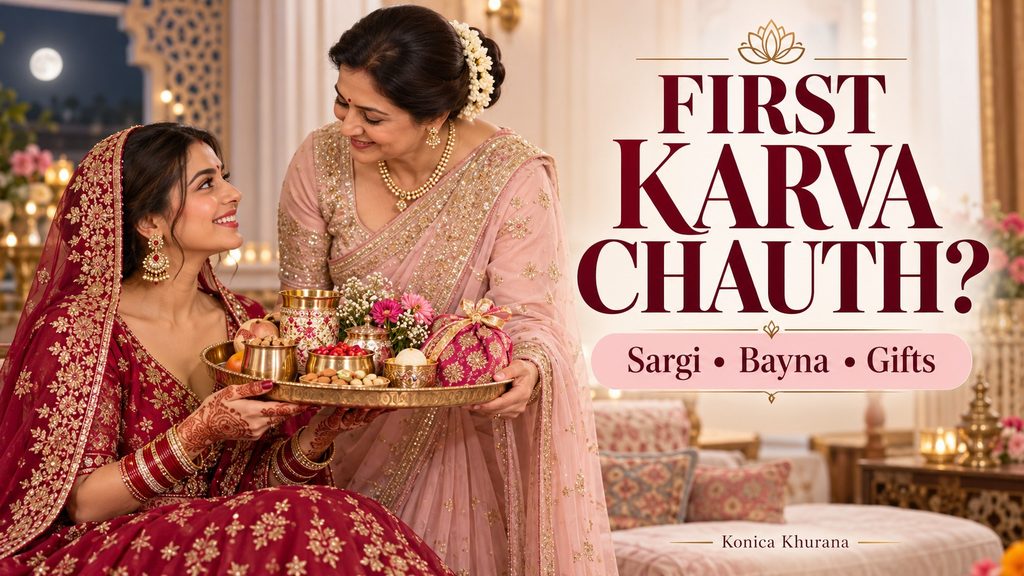
Your first Karva Chauth can feel exciting and confusing at the same time. One relative mentions sargi, another asks about bayna, and a shopping list suddenly becomes longer than expected. The easiest place to begin is a family conversation, not a large purchase.
There is no single first-year checklist that every Indian bride must follow. Find out what your own family does, agree on a comfortable budget and decide which arrangements you need help with.
What is sargi?
Sargi usually refers to the pre-dawn food associated with the fast, especially in Punjabi traditions. It is often given or arranged by the mother-in-law. A gift basket may also include clothes or adornments, although food and gifts are not identical parts of the custom in every home. [1]
Typical family choices may include fruit, dry fruits, pheni, sweets or other familiar foods. Treat this as a description of customary foods, not a compulsory menu or a medical fasting plan. You do not need an elaborate hamper to make the occasion meaningful.
What is bayna or baya?
Bayna nikalna generally means setting aside customary offerings or gifts to be presented according to the household’s practice. Baya or bayna may include food, sweets, clothes, shringar items or shagun, often associated with honouring the mother-in-law or another elder. Some families involve the woman’s maternal home in these exchanges. The direction of the gifts, recipient, contents and timing vary. [2]
Before buying anything, ask: “In our family, who receives the bayna, what do we include, and when do we present it?” This one question can prevent unnecessary expense and embarrassment.
What differs in UP, Delhi and NCR?
| Setting | Customs you may encounter | What to confirm at home |
|---|---|---|
| Some UP households | Gaur/Gauri worship, household katha and bayna traditions | Puja image or arrangement, story and recipient of bayna |
| Punjabi families, including many in Delhi NCR | Sargi, a shared katha gathering and thali-related customs | Pre-dawn arrangements and the group’s ritual sequence |
| Mixed-community homes in Delhi NCR | A combination of inherited customs | Which practices the couple and elders actually follow |
| Other parts of India | Observance may differ greatly or not be a family festival | Whether and how the family observes it |
These are examples, not rules attached to a postcode. Regional overviews describe variation, including Punjabi sargi and some UP Gaur Mata practices. Your neighbour’s ritual may therefore differ from yours without either family being “wrong”.
What should be given and received in the first year?
For a simple celebration, choose one useful gift rather than a long list. A sari or suit, a small shringar set, sweets, fruit or a handwritten note can be considered if the recipient would enjoy them. These are optional suggestions, not mandatory exchanges.
There is no universal compulsory cash amount, number of outfits or jewellery requirement. Avoid treating gifts from the bride’s parents as a debt. A warm welcome, shared preparation and kind words matter much more than matching another family’s photographs.
New marriage, new expectations? Get Your Love Reading to reflect on the questions you would like to discuss with your partner.
Your first-year planning checklist
A few days beforehand, confirm where you will spend the day, whether there is a group puja and who will bring the samagri. Ask whether the first observance is usually at the maternal or marital home in your particular family; do not assume either is compulsory.
The day before, organise clothes, gifts and meals. Ask your partner to manage errands and evening preparation. On the day, leave space to rest and enjoy the celebration rather than rushing between appointments, photographs and hosting duties.
One remedy: begin with a family harmony sankalp
At puja time, pray for kindness between both families. Afterwards, thank one person from each side for something specific they have done. If a misunderstanding exists, choose a calm time later to discuss it rather than using the festive gathering to settle it publicly.
This is a suggested faith-based and practical exercise. It does not require gifts, a particular sum of money or any promise of supernatural results.
Frequently asked questions
Is sargi compulsory in every UP family?
No. Some households observe it and others follow a different routine. Confirm your own practice.
Can I prepare sargi myself if my mother-in-law is away?
You can make practical arrangements together and ask what your family prefers. Distance need not turn the celebration into a test.
Must the first Karva Chauth be expensive?
No. Fix the budget before shopping, and keep every gift voluntary.
If family expectations are affecting your bond, Get Your Relationship Reading for a reflective look at your concerns. Also discuss the practical boundaries you and your partner need.
Read next: Karva Chauth Remedies for Love and Progress.
Sources: [1] https://www.nmcny.org/resources/karwa-chauth • [2] https://www.kcsshop.in/blogs/fashion/sargi-baya-gifts-karwa-chauth • [3] https://en.wikipedia.org/wiki/Karva_Chauth
Karva Chauth Remedies for Love, Harmony and Your Husband’s Progress
By Konica Khurana
SEO publishing fields
When people search for Karva Chauth remedies, the wish behind the search is often deeply personal: “May my husband find a better opportunity.” “May we stop arguing.” “May we feel close again.” A festival can offer a meaningful time to express those hopes.
No Karva Chauth ritual can guarantee a promotion, income increase, fidelity or reconciliation. The practices below combine personal prayer with actions that a couple can choose together. They are suggested devotional exercises, not claims that a particular scripture prescribes these exact remedies for this festival.
1. A prayer and action plan for your husband’s career
During your usual puja, offer a simple prayer to your chosen deity for wisdom, honest work and suitable opportunities. If Ganesh worship is part of your practice, you can include your familiar Ganesh prayer. There is no need to invent a compulsory chant count.
After the celebration, ask your husband which work goal matters most right now. Is he applying for a job, seeking a promotion, building a business or looking for one dependable client? Write down one goal and one action he can take this week.
For example: “Update my CV by Sunday and send two relevant applications.” Or: “Follow up respectfully with three previous enquiries.” This is a planning example, not a prediction. Your role is to support him, not to carry responsibility for his career outcomes.
2. A harmony sankalp for repeated arguments
Pray: “May we listen before reacting and speak without humiliation.” Then agree on a small rule you can actually follow: no shouting across rooms, no bringing relatives into every disagreement, or taking a pause when a conversation becomes too heated.
Choose one rule together. A promise made by only one person cannot solve a pattern involving two people. Return to the discussion when both of you are calm, and focus on one issue at a time.
Not sure why the same emotional pattern keeps returning? Get Your Relationship Reading. Bring a question about your choices, communication or boundaries. A reading should not be presented as evidence that your partner is cheating or hiding something.
3. A gratitude practice to strengthen love
Write three short sentences: “I appreciate you for…”, “I would love more of…”, and “One thing I will work on is…”. Invite your partner to do the same without demanding a particular response.
Read the notes after the puja or over dinner. Keep the request specific. “Can we spend twenty minutes together without phones on Sunday?” is easier to respond to than “You never care about me.”
4. A voluntary act of generosity
If giving is meaningful in your spiritual practice, donate food or useful essentials through a reliable local organisation within your budget. Think of it as an expression of gratitude, not a payment in exchange for blessings.
Avoid extravagant remedies, borrowed money for ritual purchases or claims that a specific expensive item is essential to remove relationship problems. A simple act is enough for a personal sankalp.
5. A shared progress page
Write two headings in a notebook: “What we hope for” and “What we can do”. Under the first, record a wish for work or home. Under the second, record one step, who will take it and when you will review it.
A career goal and a relationship goal can sit on the same page: one job application action and one weekly conversation, for instance. This makes the festival a useful starting point without promising that the date itself will change the outcome.
What should you avoid?
Do not blame a woman for her husband’s setback because she missed a ritual. Do not use a prayer to justify controlling a partner. And do not accept humiliation or mistreatment because someone says a stronger fast will fix it. Where there is fear, coercion or violence, practical safety and trusted support come before a ritual or reading.
Frequently asked questions
Which remedy guarantees a promotion?
None. Prayer may be personally meaningful; career outcomes also depend on skills, decisions, opportunities and other circumstances.
Can both partners do these practices?
Yes. Shared goodwill and practical action do not have to be one person’s responsibility.
Can a reading bring an ex back?
A reading cannot control another person’s feelings or guarantee a reunion. It can be used as a reflective tool while you consider your own decisions.
For questions about emotional connection, Get Your Love Reading. For an ongoing difficulty, Get Your Relationship Reading.
Read next: Unmarried or Engaged: Should You Keep Karva Chauth?.
Editorial note: The five exercises above are original suggested practices, not historical ritual claims. Festival background: https://www.incredibleindia.gov.in/en/festivals-and-events/karva-chauth
Can Unmarried or Engaged Women Keep Karva Chauth?
By Konica Khurana
SEO publishing fields
“My wedding is fixed. Should I keep Karva Chauth this year?” It is a common question, followed closely by another: “If I do not keep it, will my future in-laws think I do not care?”
Some unmarried and engaged women choose to observe Karva Chauth, but there is no single expectation shared by all Indian families. The festival is mainly associated with marriage, while participation by unmarried women is also described in cultural accounts. [1] Your choice should be informed, voluntary and appropriate to your circumstances.
If your marriage is fixed
Speak to your fiancé before making arrangements. Ask whether the custom exists in his family and explain what feels meaningful to you. It is reasonable to discuss a simple puja, a shared prayer or participation in the family gathering without automatically agreeing to every expectation.
An engagement is also a useful time to notice how decisions are made together. Can you say that you are uncomfortable? Does your partner listen? Are expenses and hosting duties shared fairly? Those conversations matter well beyond one festival.
If you want to keep it for your boyfriend
Reflect on why you want to do it. Is it a happy personal choice, or are you hoping the fast will secure a commitment that has not been discussed? A ritual cannot create consent, settle an uncertain relationship or oblige someone to marry you.
You can express love while also asking direct questions about the relationship. Try: “I enjoy celebrating with you, but I also want us to be clear about what we both want.” Keep the celebration separate from pressure for an answer.
Unsure where your own feelings and expectations stand? Get Your Love Reading as a reflective starting point. It cannot verify your partner’s intentions or predict their decision with certainty.
If you are single
You can use the occasion for a prayer about the qualities you hope to bring to and receive in a future relationship. Respect, honesty, emotional availability and shared values are useful themes to consider.
You do not need to select an imagined person or follow a social-media rule to make that reflection worthwhile. Remaining single or choosing not to fast does not make you less deserving of love.
Do unmarried women break the fast after stars or the moon?
Different families and popular advice sources describe different practices. Do not treat “all unmarried women must watch stars” as a universal rule. If you choose a religious observance, clarify the sequence with a trusted person from your own tradition before beginning.
Similarly, avoid assuming that the bridal symbols worn by married relatives are automatically required for you. Wear festive clothes or jewellery that feel appropriate to your own customs and preferences.
One remedy: a clarity sankalp
Sit quietly during your chosen prayer time and say: “May I recognise a relationship built on respect, honesty and mutual care. May I have the courage to communicate clearly.”
Write three qualities that matter to you and one boundary you will honour. For example: “We can disagree without insults.” This is a suggested reflection, not a manifestation guarantee or a traditional compulsory Karva Chauth rite.
What if your partner pressures you?
A useful response is: “I respect the occasion, but fasting needs to be my choice. Let us find a way to celebrate that feels right to both of us.” Observe the response rather than trying to earn acceptance through greater sacrifice.
If a pattern of control, threats or humiliation exists, seek trusted support. A reading should never be used to persuade you to ignore unsafe behaviour.
Frequently asked questions
Is it compulsory after engagement?
No universal rule makes it compulsory for every engaged woman. Discuss the specific family custom without confusing custom with obligation.
Will skipping it harm my future marriage?
There is no sound basis for treating a skipped fast as a cause of relationship failure. Communication and conduct deserve attention.
Can I participate without a strict fast?
You can discuss a suitable form of participation, such as prayer or joining the gathering. For health-related questions about fasting, seek individual medical advice.
If uncertainty is affecting the relationship, Get Your Relationship Reading to explore your own questions and possible next steps.
Read next: Solah Shringar: Meaning, Myths and Science.
Source: [1] https://www.incredibleindia.gov.in/en/festivals-and-events/karva-chauth
Karva Chauth Solah Shringar: Meaning, Myths and Science
By Konica Khurana
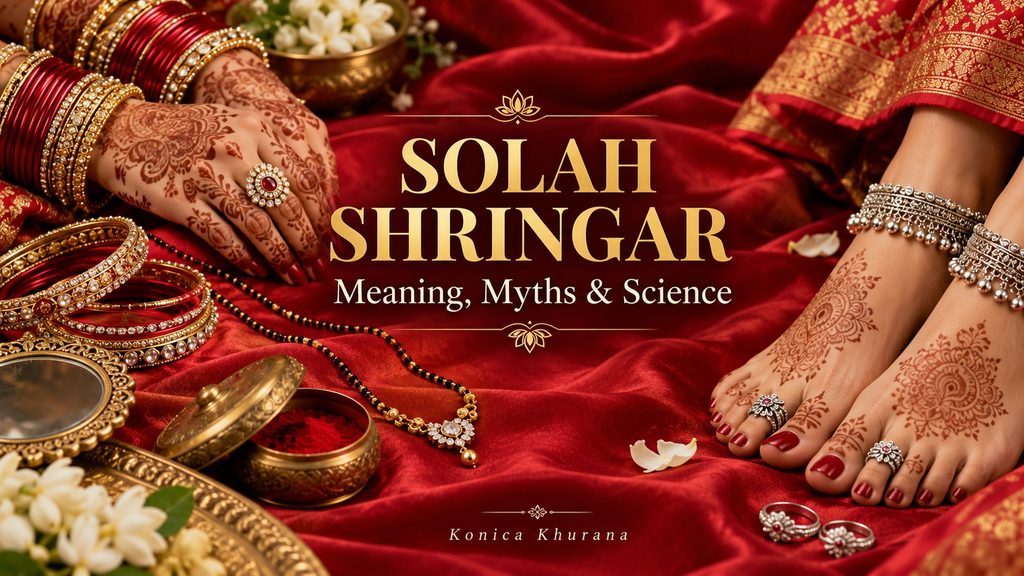
SEO publishing fields
A bindi, a set of bangles or a pair of silver anklets can connect a festive outfit to family memories. On Karva Chauth, these details often become part of a bride-like celebration. But must every woman wear every item? And are the “scientific reasons” shared online actually established facts?
Solah shringar refers to a traditional idea of sixteen adornments. Lists and meanings vary by community. Cultural or spiritual significance does not automatically establish a medical benefit. You can value the tradition without claiming that jewellery controls fertility, hormones or a partner’s lifespan.
A practical sixteen-item reference
One commonly encountered modern list includes bindi, sindoor, maang tikka, kajal, earrings, a nose ornament, a necklace or mangalsutra, bangles, mehndi, finger rings, armlets, a waist ornament, anklets, toe rings, fragrance and flowers in the hair. Other lists count clothing or hair styling differently. Treat this as a reference for styling, not a universal religious checklist. [1]
What do the familiar items mean?
| Item | Cultural or symbolic meaning in many communities | What science does not establish |
|---|---|---|
| Bindi | Auspicious adornment; sometimes associated with focus or the ajna point in spiritual interpretation | A sticker on the forehead is not proven to activate the brain or balance hormones |
| Bangles or choodiyan | Celebration and, in some traditions, married status | Their sound or movement is not an established treatment for circulation or fertility |
| Bichiya or toe rings | A marital marker in many communities | Wearing them is not a proven way to regulate periods or improve fertility |
| Payal or anklets | Beauty, movement and a familiar sound in traditional adornment | Wearing silver anklets is not an established method of removing toxins |
| Mangalsutra | A marriage symbol in communities that use it; designs vary | Its beads are not proven to protect heart health or extend a husband’s life |
| Mehndi | Festive beauty, shared preparation and celebration | The darkness of its stain cannot measure a husband’s love |
| Sindoor | A symbol of marriage in many Hindu traditions | Applying it is not a medical treatment or a guarantee of marital well-being |
These meanings are broad cultural descriptions, not instructions for every Indian woman. The symbolic role of an item can differ between families, and not all communities use a mangalsutra or the same bridal ornaments. [1][2]
Why are “scientific reasons” so common online?
A claim may sound convincing because it mentions nerves, pressure points, silver or energy. But a plausible-sounding explanation is not the same as evidence that wearing an ornament produces a health outcome.
For example, an article about a material’s properties does not by itself demonstrate that an anklet made from that material improves health. Likewise, a symbolic forehead position does not prove that a cosmetic bindi has a clinical effect. These claims should be described as beliefs unless reliable, relevant evidence supports them.
Mehndi and the myth of the dark stain
The idea that darker mehndi means greater love is a playful folk saying, not a relationship test. Do not compare your stain with another woman’s or read emotional meaning into its colour.
Product choice does matter. “Black henna” may contain added ingredients, including PPD, that can cause serious skin reactions. The FDA discusses these risks; its regulatory rules are US-specific, but the ingredient warning is relevant when choosing a product. [3] If a product causes irritation, stop using it and seek medical advice where needed.
Want to understand your relationship beyond signs and assumptions? Get Your Love Reading to reflect on your own feelings and questions. A stain, ornament or reading cannot prove another person’s love.
Do you need to buy all sixteen items?
No one should be pressured into uncomfortable jewellery or spending beyond their means. Choose pieces that fit, feel comfortable and suit your family’s celebration. An inherited pair of bangles can be more meaningful than a newly purchased full set.
The festival should not become a competition about beauty, expense or how closely someone resembles a bridal photograph. Ask what helps you enjoy the day and what you are wearing only because you fear criticism.
One remedy: attach a kind intention to your shringar
As you get ready, choose one adornment as a personal reminder: a bindi for pausing before reacting, bangles for speaking kindly, or mehndi for making time together. Say, “May I bring respect into the way I speak and act.”
This is a suggested symbolic exercise, not a claim that the item changes energy or guarantees harmony. Complete it with one real action, such as listening carefully to your partner that evening.
Frequently asked questions
Is a mangalsutra compulsory for every community?
No. Bridal and marital symbols differ across India.
Do toe rings cure menstrual problems?
They should not be presented as a treatment. Persistent symptoms need appropriate clinical advice.
Does lighter mehndi mean less love?
No. A colour result is not a measure of a relationship.
For ongoing misunderstandings, Get Your Relationship Reading and consider what direct conversation or support would be useful alongside reflection.
Read next: What Is Karva Chauth?.